Understanding how a computer program manages memory during execution is crucial for any aspiring programmer. Two key players in this memory management are the base pointer (BP) and the stack pointer (SP), registers that work behind the scenes to organize data and control the flow of your program. Knowing what these pointers are and how they function is essential for debugging, optimizing performance, and grasping lower-level programming concepts. This article will delve into the specifics of the base pointer and stack pointer, exploring their roles and significance in program execution.
What is the Stack?
Before diving into the pointers, let’s understand the stack. The stack is a region of memory used for dynamic memory allocation during program runtime. It operates on a Last-In, First-Out (LIFO) principle, much like a stack of plates. Data is “pushed” onto the top of the stack and “popped” off when no longer needed. This structure is vital for managing function calls, local variables, and program control flow.
The stack grows and shrinks as needed, accommodating the changing memory requirements of a running program. This dynamic nature makes the stack highly efficient for managing temporary data, ensuring that memory is used effectively.
Understanding the stack’s LIFO nature is key to understanding how the base and stack pointers operate. They work in tandem to track the current position within the stack and manage the data stored there.
The Base Pointer (BP)
The base pointer (BP) is a register that points to the beginning of the current stack frame. A stack frame is a section of the stack allocated for a specific function call. It contains local variables, function arguments, and the return address for resuming execution after the function completes.
The BP provides a stable reference point within the stack frame. Regardless of how the stack grows or shrinks, the BP consistently points to the base of the current function’s allocated space. This stability allows access to local variables and function arguments using fixed offsets from the BP.
For example, if a local variable is stored at BP-4, it can always be accessed at that offset, even if other data is pushed onto or popped off the stack. This consistent referencing is crucial for maintaining data integrity during program execution.
The Stack Pointer (SP)
The stack pointer (SP), on the other hand, is a register that points to the very top of the stack. It’s constantly adjusted as data is pushed onto or popped off the stack. When a function is called, the SP is decremented to allocate space for the new stack frame. Conversely, when a function returns, the SP is incremented to deallocate the space.
The SP is crucial for managing the dynamic nature of the stack. It keeps track of the available space and ensures that data is stored correctly. By continuously adjusting to changes in stack size, the SP guarantees efficient memory utilization and prevents data corruption.
Working together, the BP and SP provide a robust mechanism for organizing and managing data on the stack, enabling the efficient execution of complex programs.
Working Together: BP and SP in Action
Imagine a scenario where function A calls function B. Upon entering function B, the current BP value is pushed onto the stack. The SP is then adjusted to point to the new base of function B’s stack frame, and this new SP value is copied into the BP register. This process creates a chain of linked stack frames, allowing the program to easily return to the previous function when the current one completes.
This coordinated action is crucial for nested function calls, enabling the program to track the execution flow and maintain the integrity of the data within each function’s scope. When function B returns, the stored BP value is popped back into the BP register, effectively restoring the previous stack frame. The SP is then adjusted accordingly, deallocating the space used by function B.
This interplay between BP and SP facilitates the organized allocation and deallocation of stack memory, ensuring that data is accessible and managed efficiently throughout the program’s execution.
FAQs
Q: What happens if the stack overflows?
A: A stack overflow occurs when the stack attempts to grow beyond its allocated memory limits. This typically results in a program crash, often indicated by a “stack overflow error”.
Understanding the base pointer and stack pointer is fundamental for anyone seeking a deeper understanding of how programs work. These registers play a vital role in managing the stack, enabling the efficient execution of functions and handling data during runtime. By grasping their roles and interplay, you can gain valuable insights into memory management and program control flow. This knowledge is particularly valuable for debugging, optimization, and working with lower-level programming languages.
- BP provides a stable reference point within a stack frame.
- SP tracks the top of the stack, adjusting dynamically.
- Function call: Current BP pushed onto the stack.
- SP adjusted, new value copied to BP.
- Function return: Stored BP popped back into BP register.
For further exploration, resources like this comprehensive stack explanation and this article on memory management offer valuable insights.
Learn More about Memory ManagementExplore related concepts like heap memory, dynamic memory allocation, and register calling conventions to deepen your understanding. By delving into these areas, you can gain a comprehensive view of how programs manage memory efficiently and effectively.
Question & Answer :
Using this example coming from Wikipedia, in which DrawSquare() calls DrawLine():
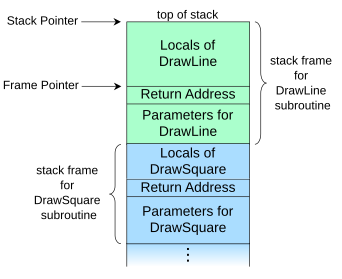
(Note that this diagram has high addresses at the bottom and low addresses at the top.)
Could anyone explain to me what ebp and esp are in this context?
From what I see, I’d say the stack pointer points always to the top of the stack, and the base pointer to the beginning of the current function? Right?
edit: I mean this in the context of Windows programs.
edit2: And how does eip work, too?
edit3: I have the following code from MSVC++:
var_C= dword ptr -0Ch var_8= dword ptr -8 var_4= dword ptr -4 hInstance= dword ptr 8 hPrevInstance= dword ptr 0Ch lpCmdLine= dword ptr 10h nShowCmd= dword ptr 14h
All of them seem to be dwords, thus taking 4 bytes each. So I can see there is a gap from hInstance to var_4 of 4 bytes. What are they? I assume it is the return address, as can be seen in the diagram from Wikipedia.
(editor’s note: removed a long quote from Michael’s answer, which doesn’t belong in the question, but a followup question was edited in):
This is because the flow of the function call is:
- Push parameters (hInstance, etc.)
- Call function, which pushes return address
- Push ebp
- Allocate space for locals
My question (last one, I hope!) now is, what exactly happens from the instant I pop the arguments of the function I want to call up to the end of the prolog? I want to know how the ebp, esp evolve during those moments (I already understood how the prolog works, I just want to know what is happening after I pushed the arguments on the stack and before the prolog).
esp is as you say it is, the top of the stack.
ebp is usually set to esp at the start of the function. Function parameters and local variables are accessed by adding and subtracting, respectively, a constant offset from ebp. All x86 calling conventions define ebp as being preserved across function calls. ebp itself actually points to the previous frame’s base pointer, which enables stack walking in a debugger and viewing other frame’s local variables to work.
Most function prologs look something like:
push ebp ; Preserve current frame pointer mov ebp, esp ; Create new frame pointer pointing to current stack top sub esp, 20 ; allocate 20 bytes worth of locals on stack.
Then later in the function you may have code like (presuming both local variables are 4 bytes)
mov [ebp-4], eax ; Store eax in first local mov ebx, [ebp - 8] ; Load ebx from second local
FPO or frame pointer omission optimization which you can enable will actually eliminate this and use ebp as another register and access locals directly off of esp, but this makes debugging a bit more difficult since the debugger can no longer directly access the stack frames of earlier function calls.
EDIT:
For your updated question, the missing two entries in the stack are:
nShowCmd = dword ptr +14h hlpCmdLine = dword ptr +10h PrevInstance = dword ptr +0Ch hInstance = dword ptr +08h return address = dword ptr +04h <== savedFramePointer = dword ptr +00h <== var_4 = dword ptr -04h var_8 = dword ptr -08h var_C = dword ptr -0Ch
This is because the flow of the function call is:
- Push parameters (
hInstance,PrevInstance,hlpCmdLine,nShowCmd) - Call function, which pushes return address
- Push
ebp - Allocate space for locals
